LinkedIn Workarounds
Posted by Marty Dickinson on Jun 2, 2015
Came across a blog post featuring 19 Ninja Tricks and man are they ever. I had to post this here so that I could go back and study each one more carefully.
Contact Facebook Support
Posted by Marty Dickinson on Oct 20, 2010
As your facebook profile or fan pages get more attention, you’re going to eventually have something go wrong with your facebook account and you’ll be searching forever for support of a facebook help issue.
Facebook might accuse you of being a spammer or one of your facebook “friends” might even turn you in by reporting you as an abusive wall poster. Maybe you just want to get your main facebook name changed and you know you can only change it once, which you’re already done.
There are countless reasons why you will eventually need to contact facebook customer service eventually. And, like many web-based systems of today, there is not a phone number to be found anywhere for support help. No, facebook supports its system entirely through support forms…dozens of them! If you have a facebook issue, use this resource for facebook support forms featuring 120 forms to use for your specific facebook support issue.
What to Post on Facebook
Posted by Marty Dickinson on Aug 1, 2010
 People are always asking me what to post on Facebook. I believe what we should be considering here is what should we post on Facebook that will build rapport with people. That’s really your main objective with Facebook in the first place, right? Next time you are struggling with what to post on Facebook, choose from this list. If you have an addition please add a comment and I will feature it in the main list.
Things to post on facebook…in no particular order of importance or success rate for accomplishing anything:
- Start a “Question of the Day” post
- Promise something special
- Post a video on someone else’s wall
- Give a case study
- Use humor
- Picture with nearly every post
- Acknowledge someone as having done a good job or achievement
- That you are available for questions in your industry
- Something you hear in the news about your industry
- Something you hear in the news about being a better parent, sibling, spouse
- New book you’ve heard about
- New website you heard just launched
- New fan page you’ve added
- New fan page someone else has added
- Video of your favorite band
- iPhone app you’ve discovered
- Tip on how to use facebook better
- Tip on how to setup your facebook profile better
- Tip on how to setup your fan page better
- New facebook api you just discovered
- Something humorous, but be careful with this one
- Entertaining picture
- Link to an ebook or whitepaper you recommend
- Link to a coupon you’ve used
- Opinion on a celebrity happening
- Discussion of hot topic (like swine flue spreading)
- Deaths and condolences
- Something involving your family that’s worth celebrating and sharing
- Great movie and how it influenced you
- Something that happened to your favorite sports team or player
- Health care industry issues
- Health advice, particularly with a health issue you had and how you fixed it
- Changes to facebook but use FB when talking about it
- Something about Twitter
- Good video of something inspiring
- How-to steps about anything
- Substantial news about you…like you’re getting married
- Your latest blog post (This could be automated by the way)
- Participation on a forum or linkedin
- #1 something of the day…I’m going to start featuring the #1 searched phrase on Google for a 24 hour period for example
- New client that starts doing business with you
- A new WordPress plugin you’ve been working with
- New Internet marketing tool you just tried
- Tribute to a veteran
- Dead relative’s birthday and what they accomplished in their life
- Scam you’ve come across that’s worth of reporting
- Virus or phishing worm that comes in by email where you can share the title so people don’t open it
- Ask a question about anything you don’t know
- Food you just tried
- Food you just learned how to make
- Restaurant you just visited for the first time
- Link to a surprising story or experience you posted in more detail on your blog
- Announce your own new book is available
- Notice that you’re back from a vacation or trip and that you have pics to share
- Announce your upcoming workshop, webinar, tele-conference
- Share that you’ve just been asked to speak and add the name of the place for some name recognition
- Accomplishment you made today
- A cause you believe in strongly and how you’re helping
- A challenge you’re having today
Another Great Turnout at Profit Again in 2010
Posted by Marty Dickinson on Jun 25, 2010
Zakary Barron from Constant Contact and I had another great turnout at Profit Again in 2010. Our workshops are typically just 3 hours from 9 to noon during a weekday so you can get your work done during the rest of the day. Looks like we might start doing these once a month as we always have a waiting list. Keep checking our Denver Internet marketing workshops page on the HereNextYear.com site and sign-up for the Tuesday Triplet and receive notices whenever we have another upcoming workshop.
At every session, we cover social networking, blogging, WordPress, SEO, video, email marketing strategies and other essentials. And, yes, that’s just 3 hours of jam packed content. Hope to see you at the next one!
Join Me at the BlogWorld Conference 2010
Posted by Marty Dickinson on Jun 10, 2010
The BlogWorld and New Media Expo and Conference 2010 is going to be the most important and opportunity-generating show it’s ever had. If you think my 3-hour workshops are “educational,” or you enjoyed watching Joel Comm speaking at AffCon 2010 in Denver, well, multiply that by about 100. The networking, the learning, the ability to talk with Internet pioneers is enough to keep you full of cutting edge tactics to try for the next six months!
Register Now through my affiliate link and use the discount coupon EBIRD. The reason you want to use the discount coupon (good only through July 15) is to get the best deal of course. The reason you want to sign-up through my affiliate link is because you will have the best experience at the conference! Here’s what will happen.
The show is on for 3 days, October 14, 15, 16. After each day worth of sessions, I will hold a one-hour group meeting with those who have signed-up through my affiliate link. Together, we will go over highlights from the sessions we attended and share contacts of interesting people we met.
It’s impossible for one person to absorb everything at a multi-day conference. And, I’m lucky if I meet more than about 20 people at an event like this because I get in such lengthy deep conversations with people that I forget to move onto the next contact! By sharing networking connections together, we will multiply our connections and network exponentially!
So, checkout the details, and
just sign-up. You’ll thank me later. Take advantage of the earlybird special discount and make sure to sign-up through my affiliate link. Then send an email to me that you have done so and I’ll add you to my list.
[Note: Yep, as an affiliate I'll be getting some commission for this sale, but I'll be putting that money to use...for you! More details later.]
See you in October at the BlogWorld Conference 2010.
Levis Proves Selling on Facebook is OK
Posted by Marty Dickinson on May 11, 2010
Whenever I give a workshop and start talking about selling on Facebook, someone eventually raises their hand and comments, “I thought if I try to sell something on Facebook that they would shut me down.” If you try to blatently spam your followers like crazy from your main Facebook account, then sure, you run the possibility of Facebook blocking your account.
But Levis are selling on Facebook just fine according to DMNews, where they talked about how Levis has made a page for their pants and are building quite the following as a result of their Facebook page promotions.
You don’t have to be Levis to sell product through Facebook. You just need to create individual Facebook “pages” for the product you’re wanting to promote and do all your promotions through those pages.
Zakary Barron of Constant Contact Presenting Email Marketing Best Practices
Posted by Marty Dickinson on May 5, 2010
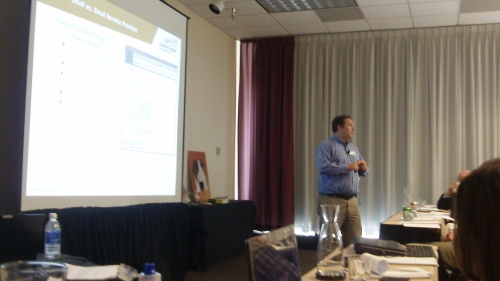 Zakary Barron is doing a great job presenting best practices of email marketing. Focus on email marketing is a great follow-up to what I was presenting to the group, which was social networking on Twitter, Facebook and Linkedin.
Highlights include:
1. Email is not dead: Proof: Didn’t you check your email this morning?
2. What are your goals?
3. Your welcome email is gold! Include your logo, salutation, welcome sentence, privacy reinforcement
4. Keep your list current
5. Provide link so people can change their profile
6. Ask for feedback
7. Survey customers to understand interests then target messages & offerings
8. Expect 15-30 open rates for emails sent out
Zakary told me our workshop was closed off to registration at 120. We had a couple of walk-ins that we managed to squeeze in, but we’re definitely going to do this again. Zak says there were 40 on a waiting list. So if you missed it, look for another workshop day to be scheduled soon! Great job Zak!
Yahoo Adopts Real-Time Search
Posted by Marty Dickinson on Feb 23, 2010
It’s all over the news. Yahoo! has finalized a partnership with Twitter to incorporate Twitter’s tweets into Yahoo!’s search database. When someone adds a tweet about a topic and it immediately displays in a search on Yahoo! based on the keywords used in the tweet, that is called real-time search.
Some people believe real-time search will overpower regular search on main search engines, thereby forcing people to be active on Twitter and other social networks if they ever hope to generate traffic from search engines.
But, that doesn’t make sense for two main reasons:
1) It will be too easy for hackers to game the real-time search system so that only their massive quantities of tweets will drive the content generated for search engines to post.
2) Standard search content will always be a necessary component of search engines because tweets can still only be 140 characters in length. And, people expect that when they do a search, that a page will display with enough content for them to be informed.
So, yes, real-time content will be an important factor of search going forward, but that doesn’t mean stop making blog posts, adding pages to your site and optimizing both of those for search engines. Search engines including Yahoo! will still need your content beyond 140 characters.
Profit Again in 2010 Workshop
Posted by Marty Dickinson on Jan 7, 2010
Using the Internet to grow your business has dramatically changed since the beginning of 2009. If you’ve been misled into thinking all it takes to be successful online today is getting a few hundred followers on Twitter, spending hours a day “Facebooking” or gaining top placement on Google for your book title or business name, we’d like to offer you a reality check…and a path for hope…for the new year!
Throughout 2010 I will be offering a new workshop called, fittingly, “Profit Again in 2010.
If you’re not familiar with me, I’m a 15-year Internet marketing “lifer,” co-authored of “Web Marketing All-in-One for Dummies” (Wiley 2009), and I’ll be using this workshop to update you on the radical progression of WordPress websites, blogs, traffic building, social networking, rss, podcasting, Federal Trade Commission restrictions and Google banning since just a year ago.
I don’t just “write and speak” about Internet marketing. I create and promotes my own products, manuals, and membership sites, with more than 100 of my own websites. Myself, along with a team of 7 at HereNextYear, Inc. have serviced more than 300+ clients nationwide.
For just one of those clients this past August, we launched just one website that enjoyed 99 product pages indexed on top of Google within 3 days. By the end of the first week, the site brought in more than $3,826 in sales. By Thanksgiving, the site delivered its first $100,000 in revenue.
Coincidence? No way. It’s the same process for any business, author or speaker…every time. All you have to do is find where you are in the process and plug in.
True success of any financial measure for your book, product or business will be no accident or stroke of luck. And, in today’s economy, you can’t afford to shoot darts at a wall in the dark!
You won’t find overnight riches or make that elusive “money while you sleep” with a casual, ho-hum approach.
And it won’t happen by changing a few meta tags on your home page.
What’s the answer? P.T.A.
1. Plug-in
2. Team-up
3. Accelerate
That’s right, just three simple steps.
First, you must identify where you are in the Internet marketing process and “plug-in” to that process. The success plan online is almost exactly the same for every business, author or speaker and hasn’t changed in almost 15 years! All you have to do is discover the process, find out where you are in that process and plug-in.
Second, team-up with those that can help you implement the process. Hiring a random website designer from Craigslist or someone from a foreign country just because you can get services for 20 cents on the dollar might have helped five years ago, but outsourcing today only helps you if you are an experienced Internet marketing project manager. You need to start now to form a devoted team that will be at your side for years to come to help you with technical challenges and smart and calculated marketing planning.
Third, only after you know the process and have a team to rely on can you expect to accelerate implementation and see the rewards.
Specifically, here’s what I will cover during any Profit Again in 2010 workshop, seminar, full-day training, or 20-minute speech:
-My 3-step process to predict whether your product or book can even be sold online or whether you should just throw it in the trash and move on
-Why Google has banned more than 150,000 websites for life in just the past month…and how to avoid being next!
-The FTC’s crackdown on misuse of testimonials and affiliate marketing and what you need to do to protect yourself from being accused of false claims…The CAN SPAM Act was only the beginning to this!
-Why every business owner, author and speaker should have “5″ websites or more…even if your competition already does!
-What keyword phrases the human population is searching online for and how you can stand in the way and benefit from that traffic
-The “new” evolution of websites and why it doesn’t even make sense to have anything else
-The secrets of social networking automation that only those with 2,000 Twitter followers or more even know about.
-How to get 300 minutes of social networking benefit for every 30 minutes you spend
-The Article Marketing Underground Triangle: How to write an article once and use what you’ve written for explosive reach to more than 30,000 websites, video directories and bookmarking sites for obscene traffic flooding whenever you want it.
-Plus, I will reveal my most closely held secret to managing what should be 10 hours a day of promotion productivity that gets accomplished in less than 60 minutes…every day.
As we roll out this essential program, look for specific dates and locations to be accessible through our main website at HereNextYear.com on our Workshops page.
7 Steps to Getting Started for New Internet Marketers
Posted by Marty Dickinson on Oct 29, 2009
Getting started on the Internet seems to most to be a hugely daunting task. But, with a few good guidelines, you will be amazed how easy and fun it really can be. Here are 7 steps to getting started for new Internet marketers:
1. Know What’s Selling Online – If nobody’s buying it and nobody’s made it yet, that most likely does not mean “opportunity” for you. So, don’t get fooled. If you want to know what people are spending their money on right now, today, one great way is to go to Amazon.com and search a category of interest. The results you get will be sorted showcasing the best selling products in that category.
2. Enjoy Being Online – If you don’t like candy, you’ll be miserable in a candy store. So, before you go putting time and effort into learning how to make money on the Internet, you must learn to enjoy sitting at a computer and typing things. Of course, I could also add-in there using your mobile device. Social media is a great way to learn to enjoy working online. Join Linkedin, join some groups and participate in some discussions. Create a Facebook profile and reconnect with friends. Start tweeting on Twitter and inspire people to “follow” you because the quality of your tweets are actually worth paying attention to. User your personal name for all of your profile account names such as Twitter.com/MartyDickinson so that people can easily find you in the future.
3. Engage Offline Networking – An online business is a lot like a traditional off-line business in that financial success in both requires “people” to buy from you eventually. Go to Meetup.com and search for a group that meets near you to discuss certain topics. I just launched a few days ago, a Meetup group of my own called “Ski With Marty,” for example. Business owners, authors, speakers, and anyone else who wants to network and get some exercise can hook up with me every Wednesday during ski season at one of our world class ski resorts here in Colorado. By the time we have our first networking event on December 2, my goal is to have 100 members in the group. Checkout Meetup.com/SkiWithMartyInColorado if you’d like to see a sample Meetup group page.
4. Love to Sell – To be successful in any business, you must adopt a deep-down belief that anything you choose to promote is not really “selling,” but more of a “recommendation” of something you’ve experienced to make other peoples’ lives better. The fastest and cheapest way to do that is to find other peoples’ products to sell, try them for yourself, and start recommending them to others. These are known as “Affiliate Products.” ClickBank.com is my favorite for finding digital, downloadable affiliate products to sell and you can often contact the product producer and request a “review copy” of their product, which is FREE of course. Their hope is that by you having the product in-hand, you will have a better understanding of the product and will give more accurate recommendations. Continuing with my example of Amazon in step 1, they of course have an affiliate program as well. But, they only pay 4% of the sale price. So, the only products worth promoting on Amazon, in my opinion, are larger ticket items (over $75).
5. Register Domain Names – Whenever I am asked “Where do I register a domain name,” I steer them to BestDomainPlace.com. That is a domain name that I registered to point to my affiliate account. When you register a domain name for promoting an affiliate product, use the URL Forwarding feature (free with BestDomainPlace.com) where a tutorial is provided. Promote your affiliate products in your social networks and whenever a related subject comes up at your in-person networking events. Last week I was talking with a parent at my kid’s school about Internet stuff and suggested she buy a domain name for her personal name at BestDomainPlace.com. Sure enough a few days later, I saw the order come in.
6. Offer Your Services – Everyone has something of value they can offer. What is the one thing that you are truly really, really good at? Connect with others on your social networks (because you enjoy doing that by this step) who are in a related area to the service you want to provide. For example, one of the services I offer is creating websites for business owners, authors and speakers. So, I went to my Linkedin profile, logged in, clicked on “Groups,” and search for “authors” then joined a group, “professional speakers” and joined a group, and then “small business” and joined a third group. Within about 60 seconds, I was connected with over 16,000 people around the country who were in my direct target audience for a service I offer. Now all I have to do is participate in the groups and offer valuable content and the contacts begin.
7. Produce a Product – If you have an idea for a product, someone else has surely produced something close. At a recent Affiliate Marketing Meetup session, a good friend and former client who went off on his own to make $40,000 a month selling affiliate products online said, “Start off small by creating your own e-book, but first buy a few of the top selling e-books for that topic and use the best parts of each to create your product.” Now, he wasn’t suggesting you just copy and paste other peoples’ books into you own. But you can use concepts of how items are presented and rewrite them with different words and different examples. And, of course, add-in your own best stuff to make the product truly unique and the best on the market. If it’s a digital, downloadable product, get it added to ClickBank.com so that other affiliate marketers will have the opportunity to sell it for you.
All of these steps and I haven’t even talked about “Starting a Website” yet. That just goes to show that there is so much you can do to get started on the Internet these days, in your spare time, on a shoestring budget. Then, when you earn a few bucks, use that income to broaden your reach…and that’s when a website, or 5, 10, 50 websites come into play.
The best time in the world to get started on the Internet is right now, today.